Tuesday, January 3, 2017

NavWorks Press Announces Release of Two New Books: Dropping Ants into Poems & Sometimes Anyway

Los Angeles, CA — NavWorks Press announces the release of two great landmark volumes of poetry, Dropping Ants into Poems, by DE Navarro, and Sometimes Anyway, a compilation of 39 remarkable poets worldwide.

ORDER discounts are available now, the books will begin to ship January 20.

Dropping Ants into Poems A masterful work of literary merit in which DE gives us 27 engaging contemporary poems, 18 Zen poems, and 1 piece of flash fiction that all work together intricately to develop the main theme of planting the seeds of words and knowledge for future generations. Includes an article on contemporary poetry, and a surprise bonus to spice things up.

DE has been called a word-master who writes with an intelligent poetic flair that demonstrates his symbiotic relationship with the English language and extraordinary ability to deliver powerful themes through words and imagery.


 * ~~~~~ * ~~~~~ * ~~~~~ *

Sometimes Anyway: Pride in Poetry Volume II
Powerful poetry by the 2016 Pride in Poetry Prize winners and selected poets. A remarkably compelling compilation of 63 poems by 39 poets from all over the world that explores the character and quality of life and humanity—past and present—in the full span of our lives. It also features 8 micro-essays.

Poems were chosen for their quality, readability, and poignant impact, and will please all poetry readers everywhere from this time forward, in every place under the sun. There is something here for everyone and everything here is for someone.


Monday, October 10, 2016

Pride in Poetry Volume II ~ Patron of the Arts

Pride in Poetry ~ Patron of the Arts

Hi, I’m DE Navarro, Author, Poet, and Editor.

I want to help new and undiscovered poets break into print.  I promote poetry and the writing arts in English worldwide.

I have undertaken a book project to publish 50 poets.
The cost of publishing a poetry book is well over $1000 when you secure ISBN, copyright, layout & design, materials, printing, and marketing.

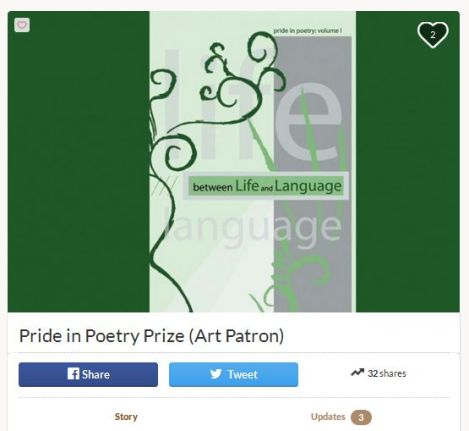
I successfully published 76 poets in 2009 in Between Life and Language: Pride in Poetry Volume I.  It helped to launch the poetic careers of a number of beginning poets who went on to win other contests, to get published, and to become poet laureates in their communities or states.

This is an opportunity for YOU to become a Patron of the Arts. Your patronage will support the production and publication of Pride in Poetry Volume II.

This is great advertisement for you or your company. Your name will be listed on the “Patron” page as one of the sponsors who made this volume possible. The amount you give will not be listed, just that you are a Patron of the Arts.

Please become a Patron of the Arts and support young and beginning poets to break into print.
The fact of the matter is, most art and literature is funded by patrons and foundations because there is no profit in it for big business.

Only people like you and me keep the arts and humanities alive in our day and time by donating time, energy, expertise and funds.

I will be doing all the production work and making up the difference in funds out of my own pocket.
It will mean a great deal to me and to 50 poets if you help with this project.  I will be extremely grateful and will honor you by sending you a complimentary copy of Pride in Poetry Volume II when it is complete (by December).

You will be proud to be a part of this volume.

Click the link to become a Patron of the Arts.
patron

Thank you again for keeping the arts and humanities alive in our world today.

Between Life and Language: Pride in Poetry Volume I

Or perhaps you'd rather submit poetry for the contest and book.  Read about it at the link below.

YES, I WANT TO SUBMIT POETRY INSTEAD.

Monday, December 9, 2013

The Resurgence of Rhyme

 To Rhyme or Not to Rhyme?


There has been a raging argument for years as to whether rhyming poetry is archaic and no longer viable and has been replaced by free verse or free style poetry that does not rhyme. Some say yes, others say no.  

I have been part of a two year debate over whether rhyming poetry is dead or not. The comments seem to be divided almost 50/50. If rhyming poetry was dead, there would not be so many publications and media formats requesting it. Ironically, rap, a style of rhyming poetry set to music and a beat, garners more interest and revenue than all other performance forms of poetry, unless you include lyrics, and then you have a whole nother category of often rhyming poetry to consider.

Both sides trade barbs. The free-stylers say that rhyming poetry is childish or pansy, too light, too humorous, too sing-songy and somewhere out of la la land. The rhymers say that free style poetry is not really poetry, rather it is nothing more than chopped up prose, it is sloppy, it is undisciplined, it does not require as much skill.

Some say that free style poetry has actually worn itself out and rhyming poetry is on a great resurgence. I'm all for a resurgence of rhyme, but by no means am I for the death of free verse or free style poetry either.

Why is it that most people want to polarize on one end or the other of an issue? Why is it that issues have to be polarized and turned into opposing views? Why can't we simply accept the congruence and harmony in many issues and understand the pragmatic balance of them?


What I am saying here is that there is room enough for both rhyming forms and free verse to be vibrant, viable and powerful ways of writing poetry, each with its own significance, each with its own unique qualities and characteristics, each with its own particular application, and each with its own impact. One thing is clear, neither style works for anyone if it is not done well.  

Poetry must be well done, crafted exquisitely, presented in a manner that exudes total natural progression.  Poetry that is not natural will not appeal to most readers. It will come across as contrived, forced and artificial which will cause it to lose its credibility. 

So why can't we accept the congruence and harmony of multiple forms of poetry, each with its own significance and each with its own power? Why must free-stylers fight with rhymers and criticize each other rather than to relish the different skills it takes to write each? Many great poets wrote both rhyming and non-rhyming poetry and did each equally well.

That's where I stand--right between, amidst and among both and all forms and styles. I write both, does that make me bi-poetic? If you only see in polarizations, perhaps. I prefer to think I am ambi-poetic, and that all poets should be to a certain degree in order to master the art of writing powerful poetry.


Please share your thoughts and also post some poems. If you post a poem, I request that you also comment on two other poems posted in the forum. Simply give your feedback on two other poems, share your impressions, why you liked the poem or where it could be made tighter, more effectual.

Please tell your poetry friends about this blog and let's make this a great place to interact and talk about everything poetic.

Challenge:  Post both a rhyming and a non-rhyming poem in the forum.

© 2013 NavWorks Press and DE Navarro. All rights reserved.

Options:

You can check out my author website DE Navarro.


And perhaps check out my newly released book, Dare to Soar.

Thank you, and have a fantastic day or night (whatever it is for you).

Sunday, August 23, 2009

Idyllic Poetry

Idyllic Poetry

An idyll (idyl) is defined as poetry that either depicts a peaceful, idealized natural country scene (an idyllic scene) or any charming, simplistic pastoral event (idyllic life). It has also come to be applied to a poem telling a story about heroes of a bygone age or era (heroes of an idyllic era). The main point of the idyl is to paint a vivid image of a charming, serene, and beautiful setting or time, whether about the setting itself or a hero within the setting.

The Greek poet Theocritus wrote ten famous idyls. Since they largely dealt with rural scenes, the term idyl came to be applied to gently flowing, artistic pieces on rural or pastoral subjects. Lord Alfred Tennyson, in the nineteenth century, wrote idyllic poetry in his Idylls of the King, which were more akin to the original, looser sense of the term idyl in describing any ideal natural setting.

So there is a whole arm of idyllic poetry that has come to be known also as pastoral poetry. Yet idyllic poetry in all its fullness is not restricted only to pastoral scenes, but any idealistic natural settings or descriptions of characters and heroes with an emphasis on their setting or landscape.

Again, the main point of the idyl is to paint a vivid image of a charming, serene, and beautiful setting or time, whether the setting itself is emphasized or a character or hero is emphasized within the setting.

CHALLENGE: Write idyllic poetry of any style, emphasizing a charming, serene and beautiful setting or time, or a character (hero) within the idyllic setting or time.

Any style or length will do. The point of an idyl is in the content, not the chosen style or form. So, if you choose a Haiku, you would have an Idyllic Haiku. If you choose a sonnet, you would have an idyllic sonnet, and on. You can also do free verse or free form idyllic poetry.

Let's enjoy a time filled
with the celebration of beautiful,
charming, idyllic and pastoral
scenes and characters.
Write on.


NavWorks Press

presents

Between Life and Language:

Pride In Poetry Volume I


A gripping anthology featuring many of your favorite MySpace Poets as well as other online and conventional poets.

Chosen by NavWorks Press for their clarity, readability, impact and pleasure, the 107 selected poems by 76 different poets fall into such categories as culture, life experience, world experience, philosophy, spirituality, nature, youth, abstractions, love and relationships, writing and poetry, and more. We know you will enjoy the diversity of topics, forms, styles and voices in this appealing anthology.

For a list of poets featured in the volume,
CLICK HERE

Click on the book cover below to find out more about this exciting volume and for ordering information.


Saturday, January 10, 2009

What Is A Poem?

What Is A Poem?

I could write a novel explaining what a poem is to me. The possibilites are vast. The poet gives the poem life in the way the words sustain it with a beat and pace all its own, unequalled in prose. A poem is. [PROSE]

===================

Poetry

I could write a novel
explaining what a poem is
to me.
The possibilites are vast.
The poet gives the poem life
in the way the words sustain it
with a beat and pace all its own,
unequalled in prose.
A poem is.

[POETRY]===================

Not a single word is different between the prose and poetry shown above. What then makes the second item a poem?

Technically, when I departed from the required rules and structure of prose, I MADE my words into a poem. I used language in a way that was not prose to make my poem come into existence.
Is it a good poem? NO! It is, indeed, a lousy poem. Its only claim to being poetry is that I used line breaks to emphasize word groupings.

You have to admit, however, that it reads differently than the prose even though the words are exactly the same. This is because the line breaks gave the words and phrases different emphasis.So, the absolute most basic definition of poetry can be: when words are used and structured in a manner apart from the requirements of prose.

Now, with a basic application of some poetic technique, let's transform this into a better poem.

A Poem Is

So vast in its potentialities,
I might write a novel
of its unimaginable intricacies,
of its departure from
prosaic rank and file,
word-art charged and transformed
with its own life-energy
given the right to dance
with its own beat, at its own pace,
in its own way
greeting many minds
living in hearts and souls.


Look at the difference a little poetic technique makes. I took the last sentence of the prose and made it the title and it flowed beautifully into the first line of the poem so that it is almost a pretext to it, which is one of the types of titles often used in poetry.

I took the concepts explained in the prose and spent some time mentally exploring them and thinking them through. Why could I write a novel about a poem? Because the possibilities are vast and extensive, the potentiality of a poem is incredible, almost unimaginable. A well crafted poem can be so intricate that multiple readings will not reveal all the goodies.

Prose is like a well arranged army in formation, marching to the cadence of the rules of prose, while poetry frees itself of this formation and dances (much more freedom) with its own beat and at its own pace in its own way and manner, uniquely structured or in free form, to capture a greater beauty than mere prose.

It's like the poet takes that rank and file prose army, separates it out, chooses particular members, and arranges groupings in the way he or she sees fit. The poet then choreographs its steps and paces, and sends it off to dance on its own, giving it its own rights and authorities and its own life.

I boiled down the thoughts and concepts of the prosaic logic and then put them together in a structure that developed itself out of the content and my heart's desire.

It is important to recognize that poetry uses poetic technique but the flow and compilation of it is from the heart. The poet must write from the heart.

As I formed the poem, I added some assonance with the short "i" sounds in line 3 (might write is actually an internal rhyme) and added the end rhyme of line 1 and 3 (potentialities / intricacies).

I added the long "a" sounds of line 4 (prosaic rank). Also, prosaic rank and file becomes an allusion of sorts to the rigors and conformed discipline of a marching army, though the word army is never used, so the metaphor (comparison) itself is implied.

Two lines later I capitalized on the army metaphor. Since rank and file implies conformity, I came out and overtly stated an opposite to conformity, that a poem is transformed.

Then lines 10, 11, and 12 are formed as a repetitive trio, giving them a unique rhythmic flow that stands out from the rest of the poem. Being short phrases ending in commas, they hold the poem back slightly in anticipation of the final lines: greeting many minds / living in hearts and souls.

As people read the poem it "greets" their mind. But as they think on it and read it again and again, it sinks deeper. Where a poem "lives" is in the hearts and souls of those who appreciate it, learn from it, grow by it, are empowered by it, entertained by it, enriched by it, or otherwise impacted.

By applying poetic technique and adorning the poem with some simple sound patterns, I transformed this poem from the conforming standards of simple prose to the wild liberty of poetic expression.

Now remember, these poetic techniques were not applied in some stuffy, calculating, methodical way. As the poet, I interacted with my material and began to form the poem by letting the words, thoughts, and ideas flow out of my heart. I then monopolized on the natural patterns present.

I have practiced these techniques often and they are a part of the repertoire of my heart, so as I interacted with my poem I naturally saw ways of tweaking certain words and phrases to add sound techniques, ways to use different words for better imagery, or ways to add new concepts that develop metaphors or add allusions, or ways to change the pace, beat, or flow.

As poets, all this comes out of our hearts. See why it is important for us to practice our craft? We read, observe, experience, and write, and write, and write. As we practice and discover techniques, they become part of our available arsenal of poetic tools, and they find their way into our poetry more and more as a natural flow out of our hearts.

As we begin to grow in certain techniques, they will often come out contrived, some of our rhymes will be forced, our metric beats will have stutters, our metaphors may seem hokey, or our allusions come off ostentatiously, or any other of a number of "amateurish" indicators.
So what? That is how we grow. I have scrapped so much of my early work in poetry, it would make most cringe. I have literally thrown away hundreds of poems. The few that survived out of my early years I have tweaked to remove the amateurish elements. The rest have survived as bits and pieces in new, better poetry.

We are poets, artists, we grow and get better at our craft with practice. Practice is born out of effort applied through time. That means, writing, writing, and more writing.

Okay, off the soap box and back to poetry, what it is. Considering our basic definition and adding the idea that poetry uses charged language that is given additional power by use of poetic technique and sound, here is what I believe to be a wonderfully open-ended, all-encompassing, basic definition of poetry:

poetry - words used and structured in a manner apart from the requirements of prose and charged with additional power by way of poetic technique and/or pleasing sound patterns

I wrote the above poem as an exercise just to illustrate the making of poetry and to explore a possible and plausible definition of it.

The poem may not be a great poem, and may never find itself into my portfolio, but it was good for illustrative and teaching purposes here today.

I hope you enjoyed it.

© Copyright 2007-2009 NavWorks Press and DE Navarro. All rights reserved.